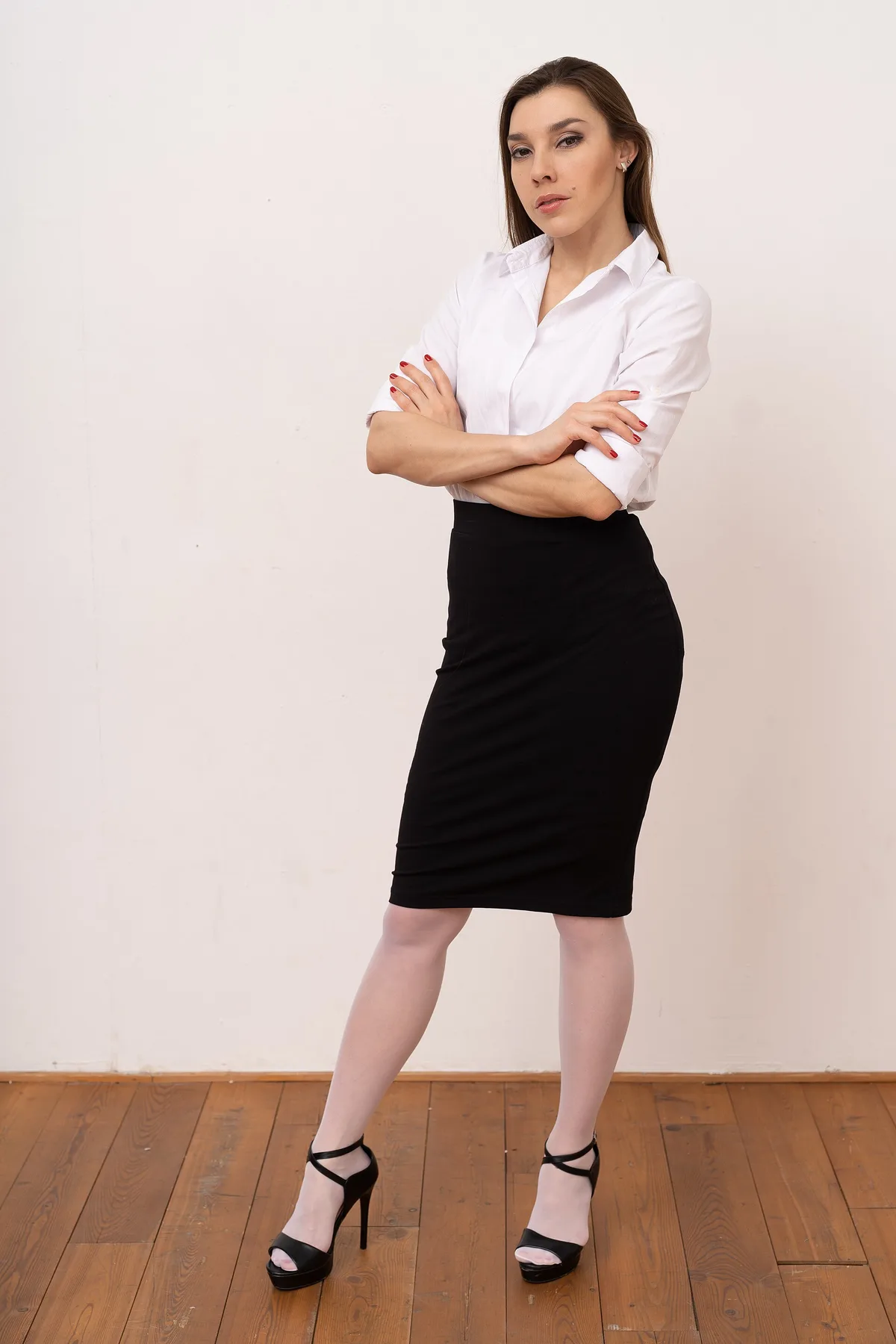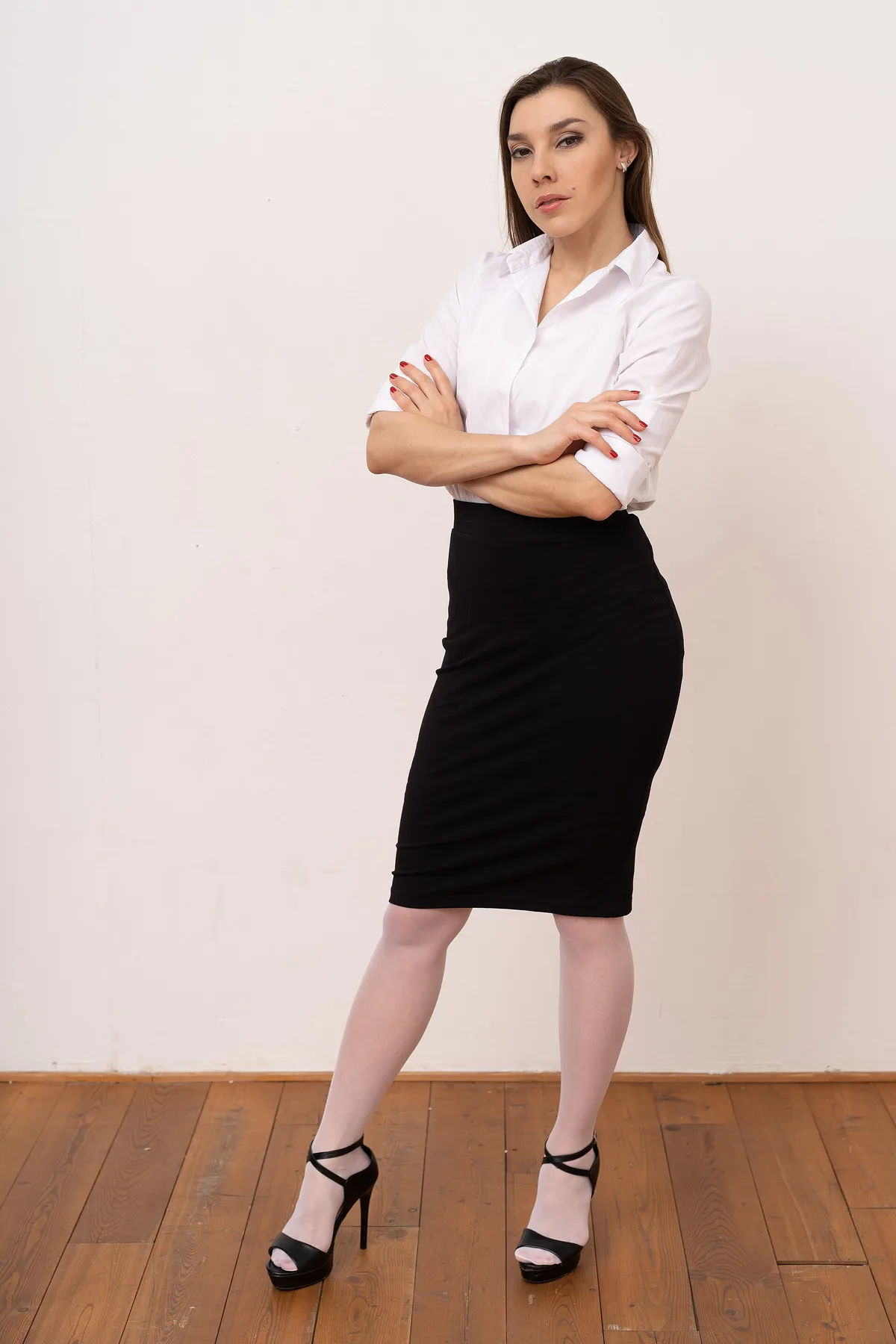
Business casual for women sits between a suit and a weekend outfit: polished pieces, worn without the full formality of tailoring. The honest answer to what it means is that it varies by office, and the reliable version is this — a blazer or structured knit, trousers or a knee-length skirt, and shoes that are not trainers. Everything else is adjustment.
The confusion is understandable. Most people now work in the private sector, in offices whose rules are set by their employer rather than by any industry standard, and those rules have loosened unevenly. One floor treats denim as dress-down Friday; the floor above has never allowed it. This guide decodes the three common dress codes — smart casual, business casual and formal — and gives real outfit examples for each, so the morning decision stops being a guess.
Because employment in most countries is overwhelmingly private-sector employment, the dress code that governs your week is almost always a company policy, not a law or an industry rule — Wikipedia's overview of business notes that most individuals are employed by businesses whose primary goal is profit, which is exactly the kind of workplace where codes drift toward whatever the team actually wears. The decode below is how to read that drift.
What is the actual difference between smart casual and business casual?
Business casual keeps one foot in the office: tailoring-adjacent pieces, closed shoes, nothing that reads as leisurewear. Smart casual relaxes the same wardrobe by one notch — good denim becomes acceptable, a fine knit replaces the blazer, and a clean leather sneaker can pass. The test is simple: business casual survives a client meeting; smart casual survives a client lunch.
A useful business casual outfit: straight-leg trousers in a neutral, a tucked white shirt, a soft-shouldered blazer, and loafers or low heels. The same pieces shift to smart casual by swapping the trousers for dark, well-fitting denim and dropping the blazer for a breton or fine merino crew. One swap, two codes. If you are unsure which side of the line a meeting sits on, dress for business casual — it is the version that reads as effort in either room. We covered a connected angle in White Shirt Styling Guide: Ten Ways to Wear the Wardrobe's Hardest Classic.
When does an occasion demand formal dress?
Formal means the suit returns, complete. For women that is a tailored suit — trouser or skirt — in a dark or neutral shade, a crisp shirt or simple shell underneath, and closed leather shoes with a modest heel or a flat if the tailoring is strong. Evening formal adds room for silk, a longer hem, and jewellery with more presence, but the structure stays.
The mistake is treating formal as "business casual plus accessories." It is a different silhouette. Formal is a line from shoulder to hem that holds its shape; business casual deliberately breaks that line with a knit, a softer trouser or an open collar. If the invitation says formal and your suit is at the tailor, a column dress with a structured jacket comes closer than any separates combination.
What should you wear for a first day or a big meeting?
For a first day, err one notch above the office norm, then calibrate. If the workplace is genuinely formal, a suit is never wrong on day one. If it is business casual, the blazer-and-trousers combination above reads as prepared without reading as overdressed. The one thing to avoid is arriving in the most relaxed possible version of the code — you can always take a layer off by lunch, but you cannot add polish you did not bring.
For a big meeting, the same logic applies with sharper execution: pressed fabric, closed shoes, jewellery kept to two or three pieces. Our analysis across the three codes is that footwear is the loudest signal in the room. A good trouser with the wrong shoe downgrades the whole outfit; the same trouser with a clean loafer holds it. Choose the shoe first and build back up from there.
Which pieces do the heavy lifting across all three codes?
A small set of pieces covers every code on this page, which is the quiet argument for building a working capsule rather than buying per occasion:
- A well-fitted blazer — formal with matching trousers, business casual over anything, smart casual over denim. The fitting details that matter most are covered in The Perfect Blazer: A Fitting Guide to Shoulders, Sleeves and Everything After.
- Dark, straight-leg trousers in a neutral — the spine of every business casual outfit here.
- A white or near-white shirt — formal under a suit, business casual tucked, smart casual open over a knit. Ten variations live in White Shirt Styling Guide: Ten Ways to Wear the Wardrobe's Hardest Classic.
- Closed leather shoes — loafers, low heels or a dressy flat.
- One structured bag — large enough for a laptop, small enough to read as considered.
That list is deliberately short. Fewer, better pieces make the code changes almost free, an idea this site's Capsule Wardrobe Guide: Building One Weekend That Lasts for Years works through in full. Accessories follow the same economy: the guide to Minimal Accessories: Fewer Pieces, Louder Effect — A Working Guide explains why two good pieces beat six competing ones, which is especially true under office lighting.
What actually ages badly in a business casual wardrobe?
Three things, in our experience of watching the codes move. First, trend-cut trousers with exaggerated proportions — the extreme versions photograph well for a season and then read as dated in a meeting. Second, cheap tailoring on the blazer: a shoulder that collapses is visible from across a room and no styling rescues it. Third, anything that needs constant maintenance to look presentable; a piece that wrinkles in a commute is a liability in every code, not just formal.
The safer buys are the unglamorous ones. A neutral trouser in a fabric with some recovery, a blazer with a real shoulder, a shirt that survives a wash cycle. These are the pieces that make style decisions easy for years rather than one season — and they are the reason the codes in this guide feel manageable rather than exhausting. Readers following this should also see The Perfect Blazer: A Fitting Guide to Shoulders, Sleeves and Everything After.
The takeaway
Business casual for women is not a mystery; it is a midpoint. Keep one tailored anchor in every outfit, read the room one notch above its norm when in doubt, and let footwear and fabric quality carry the polish that formality used to. Smart casual relaxes the anchor; formal completes it. Learn the midpoint well and the other two codes become adjustments, not puzzles — and the wardrobe that serves them is, conveniently, the smallest one.