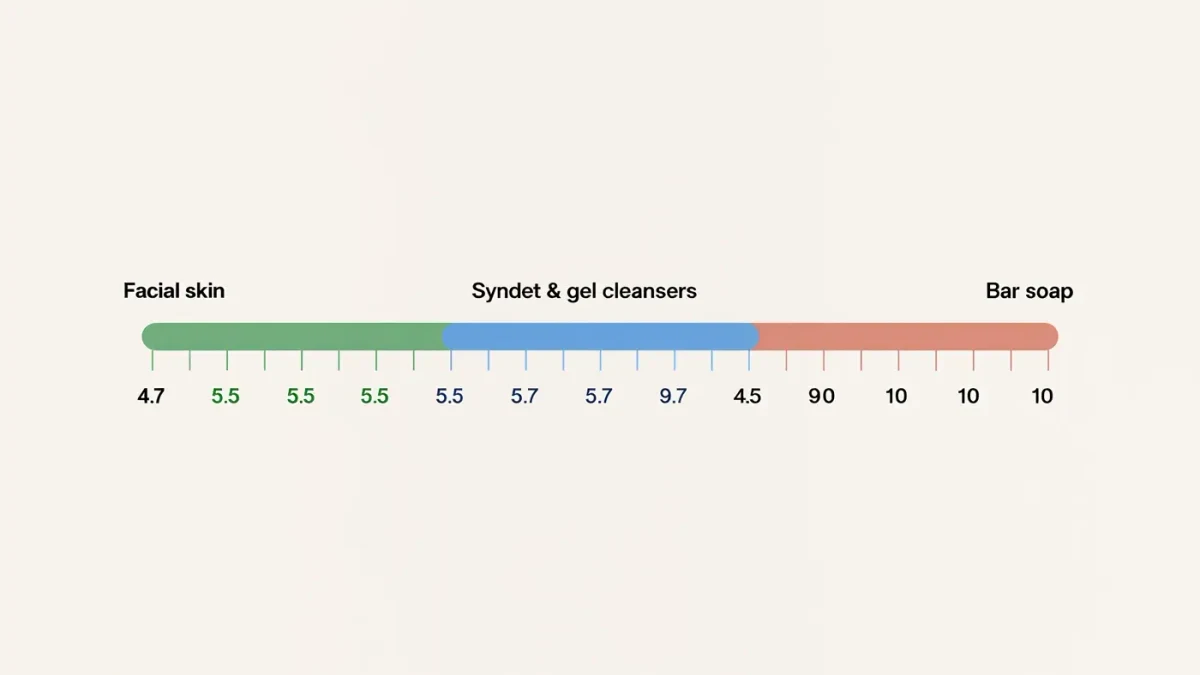
The rule is one number: healthy facial skin sits at a pH of roughly 4.7 to 5.5, while traditional bar soap measures around 9 to 10, and every wash with an alkaline cleanser drags skin briefly out of its comfort zone. Research on the so-called acid mantle shows that a cleanser at skin-friendly pH leaves the barrier's enzymes working and its lipids intact, while habitual alkaline washing raises skin's own pH, increases water loss and feeds the irritation-dryness loop most people call 'sensitive skin.' The gentlest effective cleanser, in short, beats the deepest clean — and pH is how that verdict is written in chemistry.
The usual note applies: NOOR publishes information, not medical advice. Persistent irritation, flaking or breakouts that survive a month of gentle cleansing deserve a dermatologist's diagnosis, not another bottle.
What does pH do on the skin, actually?
The skin's acidic coat — the acid mantle — is not decoration. Barrier enzymes that assemble lipids and shed dead cells operate in a narrow acidic band, around pH 5; the bacteria that normally live peaceably on skin prefer acidity, while troublemakers such as cutibacterium and staphylococcus aureus flourish as pH climbs. Controlled studies summarized in dermatology reviews found that raising skin surface pH into the alkaline range impairs enzyme function, delays barrier repair and increases transepidermal water loss. Classic soap manages this badly twice: its alkalinity strips the acid coat, and its surfactants bind to barrier proteins. The tight, squeaky feeling afterwards is the sensation of a barrier that has just been shortchanged — a sensation cosmetic marketing somehow reframed as cleanliness for a century.
Which cleansers are alkaline, and which are not?
| Cleanser type | Typical pH | Effect on skin |
|---|---|---|
| Traditional bar soap | ~9–10 | Strong alkalinity; strips acid mantle and lipids; tightness guaranteed |
| Syndet bars (synthetic detergent) | ~5.5–7 | Engineered neutral-to-acidic; far milder than soap |
| Gel cleansers (amino-acid or mild surfactant) | ~4.5–6.5 | Skin-compatible range; the everyday default |
| Cream and milk cleansers | ~5–7 | Low foam, low stripping; suits dry and mature skin |
| High-pH 'deep clean' gels | ~8–9 | Temporary squeak; contributes to chronic dryness |
| Cleansing oils and balms | ~5–6 (emulsified) | Dissolve makeup and sunscreen, rinse mild |
The 'syndet' story deserves a nod: dermatologists developed synthetic detergent bars decades ago precisely because soap's alkalinity aggravated the patients they treated, and the resulting neutral-pH bars became the dermatological standard for compromised skin. Most modern liquid cleansers inherit that logic even when the marketing forgets to mention it.
How do you tell a cleanser's pH without a lab?
Three practical tells, in order of reliability. First, the after-feel: skin should feel supple and quiet after cleansing, and any squeak, tightness or shine-by-noon rebound is a pH and surfactant verdict rendered on your own face. Second, the label vocabulary — 'pH-balanced,' 'soap-free,' 'sulfate-free,' 'amino-acid surfactants' — is marketing language, but it correlates: true soap lists 'saponified oils' or 'sodium/potassium hydroxide' high in the ingredients, while syndet and gel cleansers lead with surfactants such as cocamidopropyl betaine or sarcosinates. Third, for the exacting, pH test strips cost a few units of currency and settle any argument in thirty seconds, since a drop of cleanser in water will color-read against the chart. The deeper truth is that formula design matters alongside pH: a mild surfactant system at neutral pH beats an aggressive one at perfect acidity, and the softest wash that removes your sunscreen is the right one.
Related stories: Sleep and Skin: What Science Says About Night-Time Repair · Niacinamide, Explained: Why It Is in Nearly Every Formula Now.
Does water temperature and hardness matter?
More than the shelf suggests. Hot water swells the barrier's lipid structures and dissolves surface oils faster, so lukewarm — comfortable to the wrist — remains the dermatological default. Water hardness compounds surfactant action: the calcium and magnesium in hard water bind with cleanser residue, leaving film that itself irritates, which is why skin often behaves differently between cities. Twice-daily cleansing is not a moral schedule; oily skin benefits from a morning and evening wash, dry skin often needs only evening product and a morning water rinse, and no skin needs scrubbing. Timing helps too — a 60-second contact time is enough for any surfactant to do its job, and five minutes of lathering just extends the exposure.
What is the ideal cleansing routine for a healthy barrier?
- Choose a low-foam, skin-pH cleanser as the daily default — gel for oily skin, cream or milk for dry.
- Use lukewarm water and finish by patting, not rubbing, with a clean towel.
- Moisturize within a minute while skin is damp; the humectants trap the water the wash just delivered.
- Double-cleanse only when wearing sunscreen-heavy days or makeup: oil or balm first, gentle gel second.
- Treat tightness as data, not purity: the wash that leaves skin squeaking is the wash changing the routine's whole economics.
The verdict: pH is the least glamorous ingredient in skincare and the one everything else stands on. A cleanser that respects the acid mantle costs the same as one that does not — and every layer applied afterwards works better for it.
What do dermatologists recommend for problem skin?
The clinical defaults are instructive because they ignore the shelves entirely. Acne-prone skin is typically advised a mild foaming gel at acidic pH, with benzoyl peroxide or a topical retinoid doing the treatment work — not a harsher wash, since aggressive cleansing studies show it adds irritation without adding clearance. Rosacea-prone skin gets the mildest cream or lotion cleanser, lukewarm water, and instructions to avoid friction altogether. Eczema care goes furthest: national dermatology organizations recommend soap-free washes and soap substitutes so strictly that conventional bars are often simply banned from the household. The pattern behind all three is identical — cleansing is maintenance, not therapy, and the treatment belongs in the leave-on steps. Anyone chasing clearer skin by washing harder is pushing on the one variable the literature has already closed.
Are toners still needed to restore pH?
Mostly a legacy job. The astringent toners of past decades existed to re-acidify skin after alkaline soap, and a skin-pH cleanser deletes that task by design. Modern hydrating toners are a different product — a watery humectant layer that is pleasant and optional rather than corrective. The practical test survives from the earlier section: if skin feels comfortable after cleansing alone, no corrective step is owed. Skin that feels tight is asking for a different cleanser, not for a bottle to undo the first one's work. That subtraction is, in the end, the whole pH argument — buy the wash that leaves nothing to repair, and the routine gets shorter while its results improve.